Immune escape in metastatic breast cancer
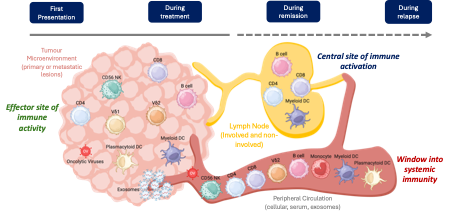
Metastatic breast cancer (MBC) accounts for the majority of breast cancer-related deaths and remains largely incurable. One of the critical challenges in MBC is the loss of effective immune surveillance, which allows tumours to progress unchecked and evade immune destruction. Our lab investigates the underlying mechanisms of immune escape during metastatic progression, with a focus on how tumour–immune crosstalk evolves across distinct anatomical compartments — including the primary tumour, tumour-draining lymph nodes, and peripheral blood. Using high-dimensional flow cytometry, serum cytokine profiling, and in vitro stimulation assays, we characterise immune cell phenotypes and functional states across these compartments. We integrate these data with spatial transcriptomic and proteomic analyses to capture microanatomical context, immune cell trafficking patterns, and tumour-driven immune modulation. Special emphasis is placed on profiling “immune outlier” patients — including exceptional survivors and rapid progressors — to identify signatures associated with long-term disease control versus immune escape. Our ultimate goal is to stratify patients based on their immune competence and uncover therapeutic targets that may restore effective anti-tumour immunity in the metastatic setting.